
Flood cleanup in Frisco, TX
Frisco's flood risk comes from creeks, not a river or coastline, but the water still counts as contaminated once it's inside your house.
Call Now(972) 449-446624/7 emergency line. Free estimates from local pros.
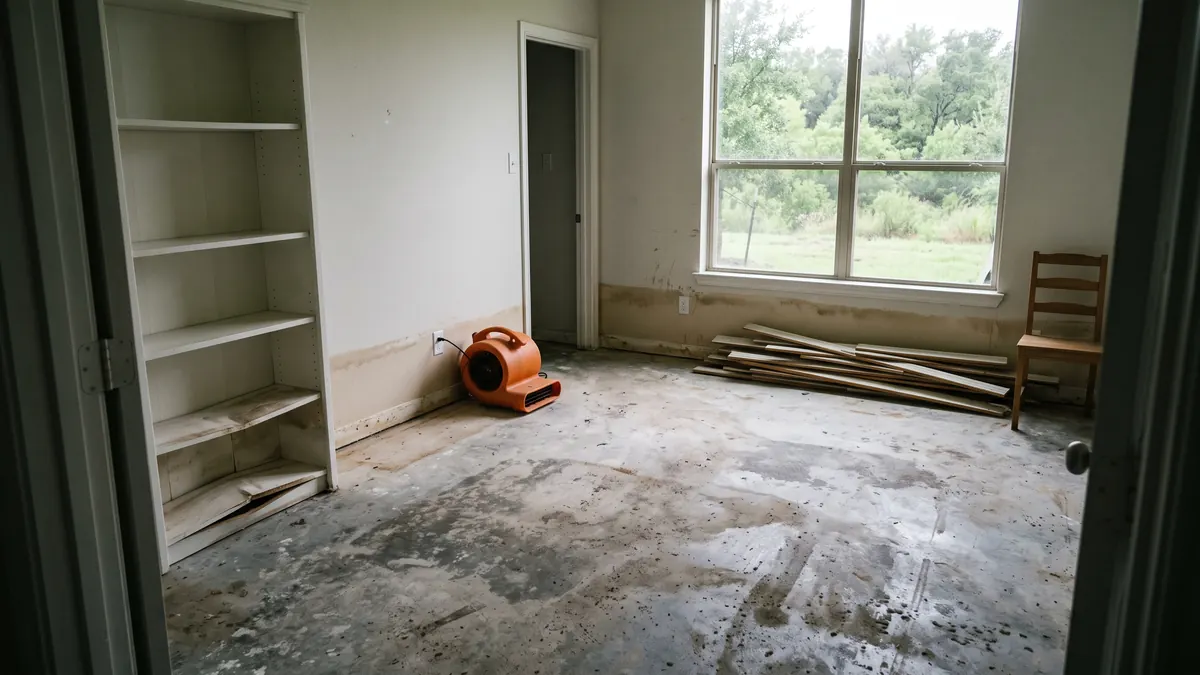
Frisco has no river running through it, and no bay anywhere close. That doesn’t mean the city stays dry. Water still gets into houses here, usually by way of a swollen creek or a storm drain that can’t keep up with a hard rain. Flood cleanup means dealing with that outside water, and it behaves differently than a burst pipe ever does.
Where Frisco’s water actually goes
Frisco drains through three creeks: Stewart Creek, Panther Creek, and Cottonwood Creek. All three eventually reach Lewisville Lake, northwest of the city. None of them is a river, and none carries storm surge. What they carry is fast, local runoff. A hard rain can push a creek out of its banks in a hurry, and the water it sends toward nearby streets and yards doesn’t take long to find the low spot in a house.
The city already drew the flood lines
Frisco takes part in the National Flood Insurance Program, and its own building rules go further than the federal minimum. New construction near a mapped floodplain has to sit at least two feet above the 100-year flood elevation, and no part of a house is allowed to sit inside that floodplain boundary at all. The maps behind those rules date back to January 1996, though the city has processed roughly 30 map revisions since, as development and drainage patterns have changed around them.
Homeowners insurance quits where floodwater starts
Where the water started is the first question a Texas homeowners policy asks. Failures that begin indoors, plumbing breaks and appliance line failures among them, generally sit on the covered side. Water that arrives from outside, rising over a yard or across a street, usually falls outside that coverage. Flood protection is its own policy, separate from homeowners insurance, and not every homeowner carries one. Which side of that line your loss falls on is what the homeowners insurance guide benchmarks in more detail.
Floodwater isn’t clean, no matter how it looks
Water that crosses open ground before it reaches your house picks things up along the way: yard chemicals, street runoff, sometimes worse. Restoration pros grade water by how contaminated it is, and floodwater almost always lands in the most contaminated tier. That changes how cleanup gets handled, and it changes what’s safe to be around. Stay out of standing water if you can’t see the bottom of it, or if it’s anywhere near an outlet or a breaker panel. Once the room is safe, call us. An independent local flood cleanup company takes the job from there.
Sorting what’s worth saving from what isn’t
Hard, sealed materials tend to come through floodwater in better shape than soft ones. Tile, sealed concrete, and most metal fixtures can usually be cleaned and kept. Carpet, its padding, and anything made of particleboard rarely survive contact with contaminated water, no matter how briefly it sat. If a backup added to the mess rather than rising water alone, the sewage cleanup page pulls apart what changes when that’s part of the picture, since it comes with its own rules on what stays and what goes. Restoration pros sort all of it by category and class, a system the water damage categories guide sketches out from clean water on up.
The trails follow the water for a reason
Frisco’s greenbelts trace the same creeks that carry its flood risk. The Cottonwood Creek Greenbelt, for one, runs alongside Cottonwood Creek itself, doing double duty as parkland and drainage corridor. That’s not an accident. Cities route trails along creeks because that low ground was already set aside for water, whether anyone’s out walking it or not. If your street backs up to one of those greenbelts, you’re closer to Frisco’s flood risk than a house a few blocks over, even if a map never singles out your address by name.
Common questions
Will my homeowners policy pay for flood cleanup?
Usually not on its own. Standard homeowners policies generally pay when the failure began indoors, not when water rises up from outside. Flood coverage is a separate policy, so check what you actually carry before you assume either way.
Is Frisco even at risk of flooding without a river?
Yes. Frisco drains through Stewart, Panther, and Cottonwood creeks, all headed toward Lewisville Lake. A hard rain can push any of them out of their banks fast, and that water finds low ground the same way river flooding does.
What actually happens to things floodwater touches?
It depends on the material and how long it sat. Hard, sealed surfaces like tile and sealed concrete usually clean up fine. Carpet, upholstered furniture, and particleboard rarely survive contact with floodwater, since it's treated as heavily contaminated no matter how clean it looks.
Is water backing up through a drain the same as flood damage?
Not exactly, though it's often handled with the same caution. A backup starts inside your plumbing rather than rising over the yard, and it can carry its own contamination. The insurance treatment can differ, so it's worth sorting out which one actually happened.
Related pages
Appliance leak cleanup
Upstairs, a water heater or laundry line fails quietly. Downstairs, it shows up on the ceiling.
Learn more →Burst Pipe Cleanup
A burst pipe in a newer Frisco home is still a burst pipe. Here's why it happens and what to do once the water's off.
Learn more →Ceiling water damage
The ceiling shows where water landed. It rarely shows where the leak started.
Learn more →Commercial water damage
A house can sit half-dry for a week. A business usually can't.
Learn more →Talk to a local pro now
We answer 24/7. One call gets a Frisco crew moving on your water damage, with a free estimate and help with your insurance claim.
Call Now(972) 449-4466Free estimates. No obligation to hire.